Times Herald Staff Writer
Tom Sheehan, a player-manager for the only professional sports
enterprise in the history of Carroll, the baseball Merchants of the
early 1950s, is one of those rare people who seemingly enjoyed
universal respect, friends and associates say.
“The essence of Tom Sheehan was that he liked people and people liked
Tom,” said James B. Wilson, publisher of the Daily Times Herald and a
close Sheehan friend.
in the early morning hours of The Fourth of July, a fitting departure
date for this product of the Greatest Generation, a man who served in
World War II, came back and played baseball both at the college level
and professionally and then, as a salesman, helped build Farner-Bocken into a
Mr. Sheehan was born on August 13, 1922, at New Haven, Conn., the son
of Thomas and Bridget (Cull) Sheehan, Sr.
An Irishman with more than a little touch of superstition, he always
told people his birthday was Aug. 12 because he never wanted to mark a
year’s passing on a dreaded Friday the 13th.
He graduated from Hillhouse High School in New Haven with a scrapbook
of newspaper clippings attesting to his athletic achievements and then
attended the University of Notre Dame in South Bend, Ind.
He entered the U.S. Navy in 1943 and served during World War II in the
Asiatic-Pacific Theater. He was honorably discharged in 1946 and
returned to Notre Dame and graduated in 1947.

as well as a member of the basketball team.
“Tom was really a hero at Notre Dame,” said Fred Dolezal, a Carroll
insurance man who also graduated from that prestigious university.
“That was in an era when the boys were coming back from the Second
World War. That was a golden era for Notre Dame sports.”
In fact, Notre Dame baseball mentor Jake Kline said in the early 1940s
that Sheehan was the best college catcher in the nation.
“Three major league clubs want him but they won’t touch him until
after the war,” Kline told an East Coast reporter. “The boy’s not only
a great catcher but a good hitter. He hit a homer against Great Lakes
in the spring and I’m sure he’ll make the grade if he ever goes into professional ball.”
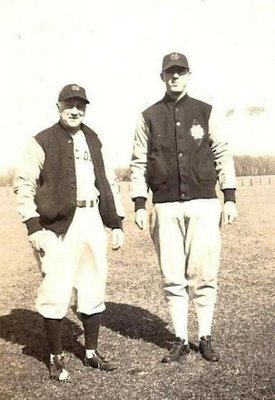
lured, remarkably, considering today’s Major League Baseball salaries,
by more money in Carroll.
Sheehan’s name is featured prominently at Notre Dame landmarks.
While in South Bend, Sheehan developed lasting friendships with some
Fighting Irish legends. He roomed with Johnny Lujack, the Heisman
Trophy-winning running back who went on to play for George Halas’
Chicago Bears.
Now living in Arizona, Lujack called the Sheehan family this week to
offer condolences on the death of his college chum.
“A lot of Tom’s stories had to do with Notre Dame,” said Dolezal,
whose own son, Tim, a Kuemper Catholic High School graduate, was Notre
Dame’s valedictorian. “I know some of you got tired of the Notre Dame
stories but obviously I didn’t. I enjoyed them all.”

Merchants semi-pro baseball team.
Carroll played in the Iowa State League, a circuit that enjoyed
success in the early 1950s before television dominated leisure time.
And in this league Sheehan was the star.
Former Carroll Daily Times Herald sports editor Howard Brantz wrote in
a column that fans from area teams went after Sheehan in much the same
way they now taunt Major League players who bat .359 — as Sheehan did
in 1950 for the Merchants when the team won the league pennant.
“The Carroll manager is our candidate for the best drawing card in the
league,” Brantz wrote. “You ought to hear the fans in opponents’
parks. It sounds more like they come out to ride Sheehan than see the
game. That’s no alibi for Sheehan or the Merchants. In fact, Tom
laughs about the fans getting on him.”
Sheehan told Brantz, “When the fans are on me they give the umpire and
other players a rest.”
much about Sheehan’s character.
“As many of you know from his obituary Tom had a remarkable athletic
career before he arrived in Carroll as manager of the Carroll
Merchants baseball team,” Wilson said. “But he never seemed to crave
attention because of his exploits nor boast of his accomplishments at
Notre Dame or later. He could tell stories for hours about his days in
athletics, but they were almost always about others, not about
himself.”
Wilson recalled taking a plane into Chicago a number of years ago and
boarding a bus for downtown. Wilson found himself across the aisle
from George Connor, the legendary Notre Dame all-American tackle,
Chicago Bear and member of the National Football League Hall of Fame.
“He was returning to Chicago from New Jersey where he had done color
commentary for the Notre Dame-Rutgers football game the day before,”
Wilson said. “We started visiting and when I said I was from Carroll,
Iowa, he immediately asked me if I knew Tom Sheehan. Connor related
several stories about Tom at Notre Dame and I filled him in on his
life in Carroll, both enjoying hearing the other talk about our friend
Tom.”
Wilson said he and Connor could have sat in those two seats telling
Sheehan stories all day.
“As we left the bus Connor’s final comment was, ‘Tom was a really good
guy and a darned good athlete to boot,’” Wilson said.
friendships.
Sheehan’s wife, Betty, a Nevada native and the long-time former
Carroll County Recorder, met Tom while she was working as a clerk for
the City of Ames.
‘Hey! Who’s that good-looking chick over there? I’ve got to meet her,”
Betty recalled with her usual dry wit, in a 1992 interview with Times Herald reporter
he fell in love with Carroll, and vice-versa.”
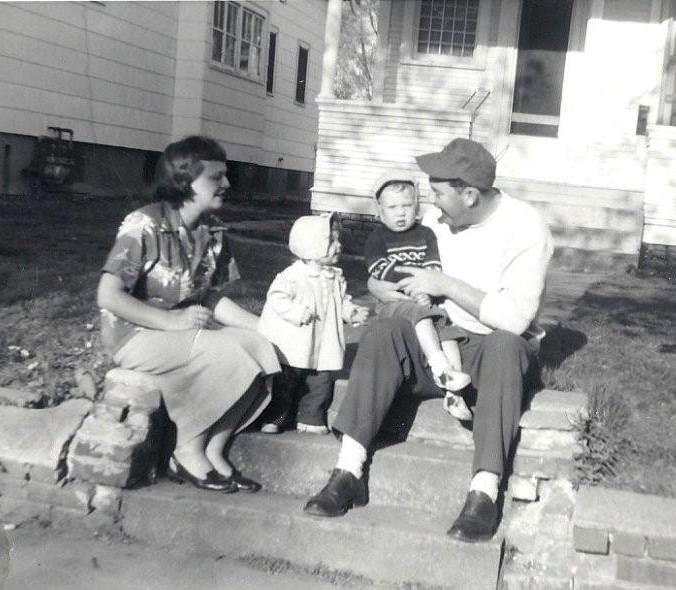
 Kitty Sheehan